
AI and the Future of Work in South-East Europe: Are We Ready for the Next Chapter?

What used to be a “nice to have” tool in development environments is now becoming a default layer in everyday work, from software engineering and customer support to HR, marketing, and operations. Across global tech teams, the conversation is no longer about whether AI should be used, but how deeply it should be integrated into workflows, decision-making, and organizational structure.
But while global trends are well documented, one important question remains largely unanswered:
A global shift, but uneven local visibility
In leading tech markets, AI adoption is accelerating quickly. Developers are using AI copilots as standard tools. Companies are building internal AI platforms. Leadership teams are redefining productivity metrics around AI-assisted output.
Yet the impact of this transformation is not uniform across regions.
South-East Europe, despite its strong engineering talent pool and rapidly growing IT sector, still lacks structured, consistent data on how AI is changing work at scale.
We know AI is being used.
We don’t yet fully understand how it is shaping teams, productivity, skills, and workplace culture in the region.
And that gap matters.
Because without regional data, companies are forced to rely on global assumptions that may not reflect local realities.
The real shift: from tools to workforce transformation
In reality, AI is starting to reshape how work itself is structured.
Across teams, we are seeing changes such as:
- Developers spending less time writing boilerplate and more time reviewing and validating code
- Managers relying on AI-generated summaries for decision-making
- Support teams scaling output without scaling headcount
- Employees increasingly expected to understand and work alongside AI systems
- New expectations around speed, iteration, and adaptability
And that shift raises new questions:
- How confident are employees in using AI?
- Do teams have clear guidelines, or are they improvising?
- Is AI improving collaboration, or creating new friction?
- Are organizations actually measuring AI impact in a structured way?
- These are not theoretical questions anymore. They are operational realities.
South-East Europe: a region at a turning point
On one hand, the region has:
- Strong engineering and technical talent
- A competitive cost base compared to Western Europe
- A growing number of outsourcing and product companies
- Increasing integration with EU digital markets
On the other hand, many organizations are still in the early phases of structured AI adoption. In many cases, usage is happening bottom-up, driven by individuals rather than coordinated organizational strategy.
The opportunity is clear: the region can accelerate quickly if it aligns talent, education, and business strategy around AI.
The risk is equally clear: without understanding how AI is actually impacting work, companies may fall into fragmented adoption - where tools exist, but value is inconsistent.
To move forward, we need more than opinions.
We need data.
Introducing the first regional AI Impact on Work benchmark
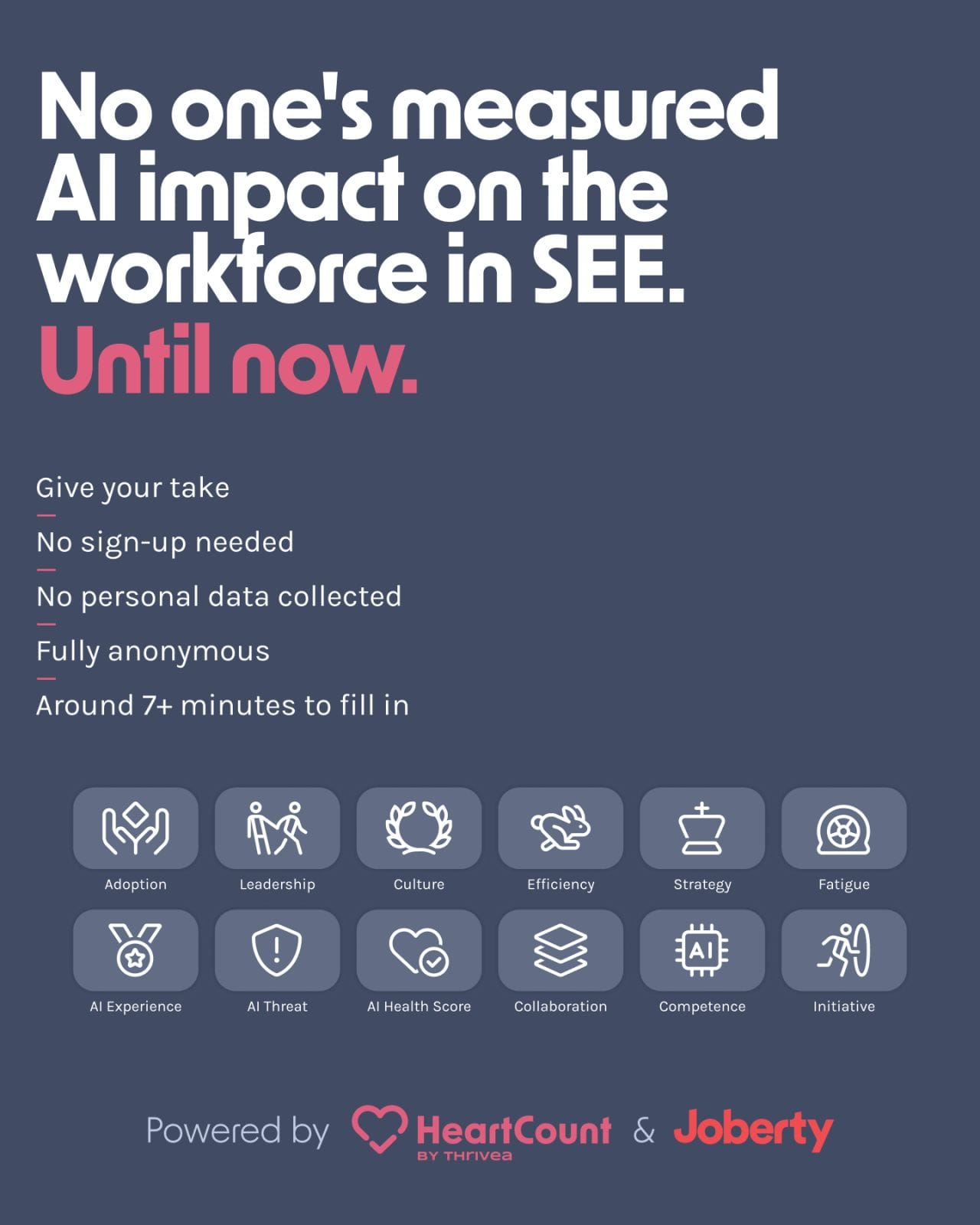
To better understand this transformation, we are collaborating with HeartCount on the AI Impact on Work Survey, the first comprehensive regional study on how AI is affecting workplaces across South-East Europe.
The survey focuses on real workplace dynamics, including:
- AI adoption across roles and industries
- Employee confidence and readiness
- Leadership support and communication
- Impact on productivity and collaboration
- Perceived changes in workload and job structure
- Organizational readiness for AI-driven transformation
You can take part in the anonymous survey here:
👉 https://heartcount.com/ai-impact-on-work-survey/
After the survey closes, the data will be analyzed and processed, and a comprehensive report will be published.
Why this matters
The value of this initiative is not just in the data itself, but in what it enables.
For the first time, companies in the region will be able to:
- Compare themselves against a regional benchmark
- Understand how their AI adoption compares to peers
- Identify gaps between tool usage and actual value creation
- Make more informed decisions about workforce strategy
Most importantly, it helps move the conversation from anecdotal experience to measurable insight.
Looking ahead
AI is reshaping work globally, but its impact is not evenly distributed.
That will not happen through tools alone.
It will happen through people, processes, and a clearer understanding of how work is actually changing.
This is the first step toward building that understanding.
And we invite you to be part of it. ❤️