
The Death of Entry-Level IT Jobs? What AI Really Means for Junior Developers in 2026

Is AI replacing junior developers?
Over the past two years, artificial intelligence has transformed software development faster than almost any technology before it. Tools like GitHub Copilot, ChatGPT, Claude, Gemini, and various AI coding agents can now generate code, debug applications, write documentation, and even build entire prototypes in minutes.
As organizations increasingly adopt AI-powered development workflows, a difficult question has emerged:
Are entry-level IT jobs disappearing?
The answer is both yes and no.
While AI is automating many of the tasks traditionally assigned to junior developers, it is also creating new opportunities and redefining what an entry-level role looks like. Rather than eliminating junior developers entirely, AI is changing the skills employers expect from them.
The real challenge for aspiring developers is not competing against AI, it is learning how to work alongside it.
Why entry-level roles are under pressure
Historically, junior developers were hired to handle repetitive and lower-risk tasks such as:
- Writing simple code modules
- Fixing minor bugs
- Creating documentation
- Building user interface components
- Performing basic testing
Today, AI tools can complete many of these tasks within seconds.
A senior developer equipped with advanced AI assistants can often produce work that previously required multiple team members. This shift is causing some organizations to reduce hiring for traditional entry-level positions while focusing on more experienced professionals who can effectively supervise AI-generated output.
For companies facing economic uncertainty and increasing pressure to improve productivity, the business case is obvious. Why hire several junior developers when a smaller team supported by AI can accomplish similar results?
However, this perspective only tells part of the story.
AI is replacing certain tasks
One of the biggest misconceptions surrounding AI is that it replaces entire jobs.
In reality, AI tends to automate specific activities rather than entire professions.
Software development involves far more than writing code. Developers are responsible for:
- Understanding business requirements
- Designing system architecture
- Evaluating trade-offs
- Ensuring security and compliance
- Collaborating with stakeholders
- Troubleshooting complex issues
- Making strategic technical decisions
These responsibilities require human judgment, communication, and contextual understanding that AI still struggles to replicate consistently.
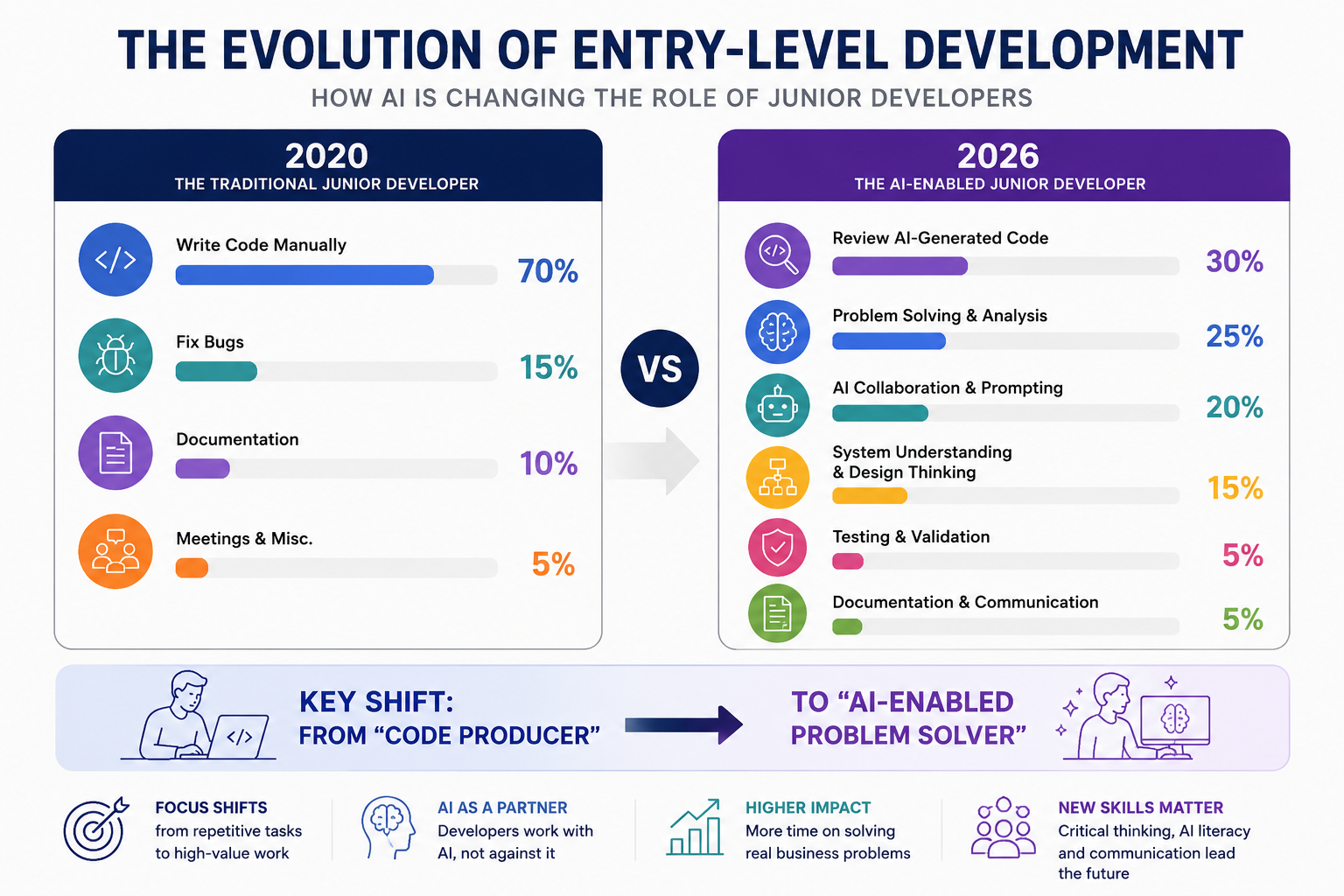
Instead of spending hours writing boilerplate code, junior developers are increasingly expected to review, validate, improve, and integrate AI-generated solutions.
The rise of the AI-assisted developer
Modern development workflows often involve:
- Using AI to generate an initial solution.
- Reviewing the generated code.
- Identifying errors or security concerns.
- Optimizing performance.
- Adapting the solution to business requirements.
- Testing and validating results.
This shift is creating a new role that some industry experts describe as an "AI-assisted" or "AI-supervised" developer.
In this environment, the ability to critically evaluate AI output becomes just as important as the ability to write code from scratch.
What employers are looking for in junior developers
As AI changes software engineering, hiring managers are adapting their expectations. Technical knowledge remains important, but employers are increasingly prioritizing:
Problem-Solving Skills - Can the candidate understand a business problem and design an effective solution?
AI Literacy - Can they use AI tools productively without becoming overly dependent on them?
Code Review Capabilities - Can they identify mistakes, inefficiencies, or vulnerabilities in AI-generated code?
Communication Skills - Can they explain technical concepts clearly to team members and stakeholders?
Continuous Learning - Technology evolves rapidly. Employers want candidates who can learn new tools and adapt to changing environments.
In many organizations, these skills are becoming more valuable than memorizing syntax or frameworks.
The new entry-level developer skill stack
The traditional junior developer skill stack focused heavily on coding.
The modern skill stack looks different:
Technical Skills
- Programming fundamentals
- APIs and integrations
- Cloud platforms
- Cybersecurity basics
- Database management
AI Skills
- Prompt engineering
- AI-assisted development
- Code validation
- Workflow automation
Human Skills
- Critical thinking
- Communication
- Collaboration
- Adaptability
Infographic: The evolution of entry-level development
What this means for students and career changers
For aspiring developers, the current landscape may appear intimidating. Many fear that AI has eliminated the need for junior talent altogether. Fortunately, this is not the case.
Companies will continue to need new developers because experienced professionals cannot be created without first gaining practical experience. The challenge is that the pathway into the industry is changing.
Rather than focusing exclusively on coding tutorials, aspiring developers should:
- Build real-world projects
- Learn how to use AI development tools
- Contribute to open-source projects
- Develop strong communication skills
- Create portfolios that demonstrate problem-solving abilities
Employers increasingly value practical experience over theoretical knowledge alone.
A strong GitHub portfolio often speaks louder than a list of completed courses.
What this means for employers
Today's junior developers become tomorrow's senior engineers, architects, and technical leaders.
Forward-thinking companies are therefore adopting a balanced approach:
- Using AI to improve productivity
- Maintaining graduate and internship programs
- Training employees to work effectively with AI
- Investing in mentorship and upskilling
Businesses that successfully combine human talent with AI capabilities are likely to achieve the greatest long-term success.
The future is collaboration, not replacement
The narrative that AI will completely replace software developers makes for attention-grabbing headlines, but reality is far more nuanced.
AI is undoubtedly changing software engineering and reducing the need for certain repetitive tasks. Traditional entry-level responsibilities are evolving, and some organizations are hiring differently than they did just a few years ago.
The developers who thrive in 2026 will not be those who compete with AI.
They will be those who learn how to direct it, challenge it, improve it, and use it to solve meaningful problems.
The entry-level IT job is not dead. It is simply being rewritten.