Investing for IT Professionals: Where to Start and What to Avoid

IT professionals spend much of their careers solving complex problems, evaluating risks, and finding ways to make systems more efficient. But when it comes to managing personal finances, those same skills don't always translate into better decisions.
With relatively high earning potential and opportunities to build long-term savings, many people working in tech face a different challenge: deciding what to do with the money they aren't spending.
Should it remain in a savings account? Is investing worth the risk? And how do you know when it's the right time to start?
To explore these questions, Joberty spoke with Professor Nikola Stakić, Portfolio Manager at Eclectica Capital, an investment fund management company. The conversation focuses on financial habits within the IT community, the importance of investment horizons, and the difference between protecting wealth and growing it.
High salaries, savings, and the money that stays still
IT professionals are often associated with above-average salaries and strong analytical skills. Does that translate into better financial decisions?
You have tens of thousands of people with incomes well above average, a high degree of financial literacy in everything except their own finances, and a habit of setting money aside - that famous "10% every month". And then, in the overwhelming majority of cases, that money ends up in a foreign-currency account doing absolutely nothing.
We tried to put a number on it. If you take a conservative estimate of 120,000 people in the sector and assume each of them sets aside that 10%, the return this community has missed out on over the past six years runs into hundreds of millions of euros. That isn't money anyone lost on the market. That's money that never started working in the first place.
So, is investing the logical next step?
In my experience, that is the one mistake that genuinely costs people. They start with "what should I invest in?" That's the wrong first step, because there is no general answer to it.
There is only an answer that depends on when you'll actually need to use the money. If you need it in six months, no return on earth is worth the risk of it not being there. If you don't need it for twenty years, then leaving it in an account is the most expensive decision you can make. The same money, two diametrically opposed recommendations - and the difference between them isn't the instrument; it's the investment horizon.
Three time horizons, three different approaches
What does that look like in practice?
Contrary to what people tend to assume, it isn't complicated. You sit down and divide your assets into three groups - not by what they are, but by when you'll need them.
The first is money that has to be available almost immediately: a buffer for the unexpected, a planned major purchase, a rainy-day stash. The second is money you won't need any time soon but don't want to forget about entirely - say, five to ten years out. The third is what you're building for a horizon measured in decades: retirement, your children's education, financial independence in some form.
Once you've done that, "what should I invest in" stops being one question and turns into three - and each of them has a far clearer answer.
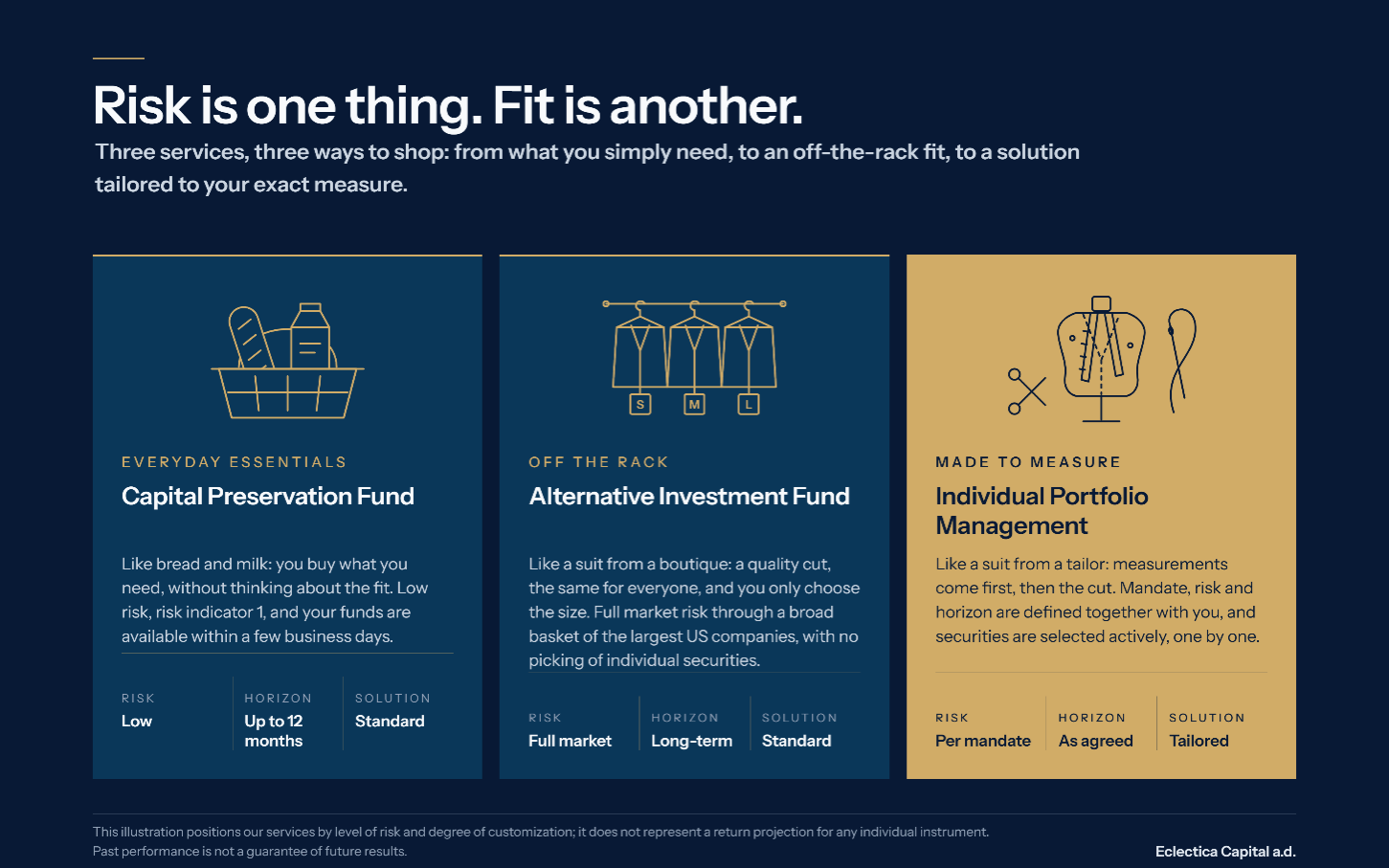
This distinction also provides a useful way to understand the three services offered by Eclectica Capital: a capital preservation fund, an alternative investment fund, and individual portfolio management.
But choosing a more personalised service doesn't automatically mean taking on more risk.
Does having more money mean someone should consider individual portfolio management?
But the size of your assets only determines whether individual management is feasible, not whether it is necessary. There are plenty of people for whom two funds and a standing order solve everything that needs solving, and it would be irresponsible to send someone to the tailor simply because they can afford it.
Risk isn't always what it looks like
One of the biggest barriers to investing is the fear of losing money. Yet, according to Stakić, the way people understand financial risk often overlooks an important distinction.
What does risk actually mean in practice?
The first is volatility: how much the value swings. The second is permanent loss: how much money disappears for good. They are not the same thing, and they often move in opposite directions. A broadly diversified equity index has high volatility and, over a long enough period, historically a low probability of permanent loss. Money sitting in a demand deposit has zero volatility and, with the inflation we've had, a practically guaranteed permanent loss of purchasing power. Over the past six years, that came to about a third of its value.
So the instrument that looks safest was the only one where the loss was certain. People flee from the swings and never notice the erosion, because the swings show up on your statement and the erosion only shows up at the checkout.
When the engineering mindset becomes a disadvantage
Analytical thinking, problem-solving, and continuous improvement are valuable skills in technology. In financial markets, however, the instinct to constantly intervene can work against long-term goals.
What's the most common investing mistake you see among IT professionals?
Trying to solve investing like an engineering problem.
There is data on it: the average individual investor ends up with a worse result than the very fund they are invested in - not because of fees, but because of when they get in and when they get out. They buy when optimism is everywhere and sell when fear takes over.
A portfolio isn't a system waiting for you to fix it. It is a system that works best when you leave it alone. That turns out to be the rarest skill of all - and the only one genuinely required here.
The second mistake is the opposite one: complete paralysis. Waiting for "the right moment", which as a rule never looks quite right enough. And the arithmetic is unforgiving - time in the market almost always beats timing the market.
Where should someone begin?
For professionals who are only beginning to think about their long-term finances, the number of available investment options can make the first decision feel unnecessarily complicated.
What would you say to someone reading this and wondering where to begin?
Not to begin by choosing an instrument.
Start by sitting down and splitting your money by time frame - what you need within a year, what within five, what not before twenty. That is an hour's work, and it requires no financial knowledge at all. After that, the choice of instrument will seem almost obvious, because you will be asking the right question for the first time.
And don't look for the best possible outcome. Look for the outcome you can live through. A smaller position you will hold through a drawdown is worth more than a larger one you will abandon at the worst possible moment. That applies to someone putting aside €200 a month and to someone with two million in the account alike.
Money that sits still isn't neutral. Every month it makes a decision on your behalf - it is just that the decision is always the same one, and always at your expense.
What does it come down to?
For IT professionals, financial planning doesn't have to start with understanding every investment instrument or predicting market movements. As this conversation suggests, a more useful starting point may simply be understanding personal goals, time horizons, and the level of uncertainty one can realistically accept.
Eclectica Capital joins Joberty as a partner, bringing a perspective on personal finance and long-term wealth management to the community. In upcoming articles, we'll explore the different approaches to investing in more detail.
Editor's note: The views and estimates expressed in this interview are those of Professor Nikola Stakić. This article is intended for educational purposes and does not constitute personalised investment advice. Investment values and returns are not guaranteed.