
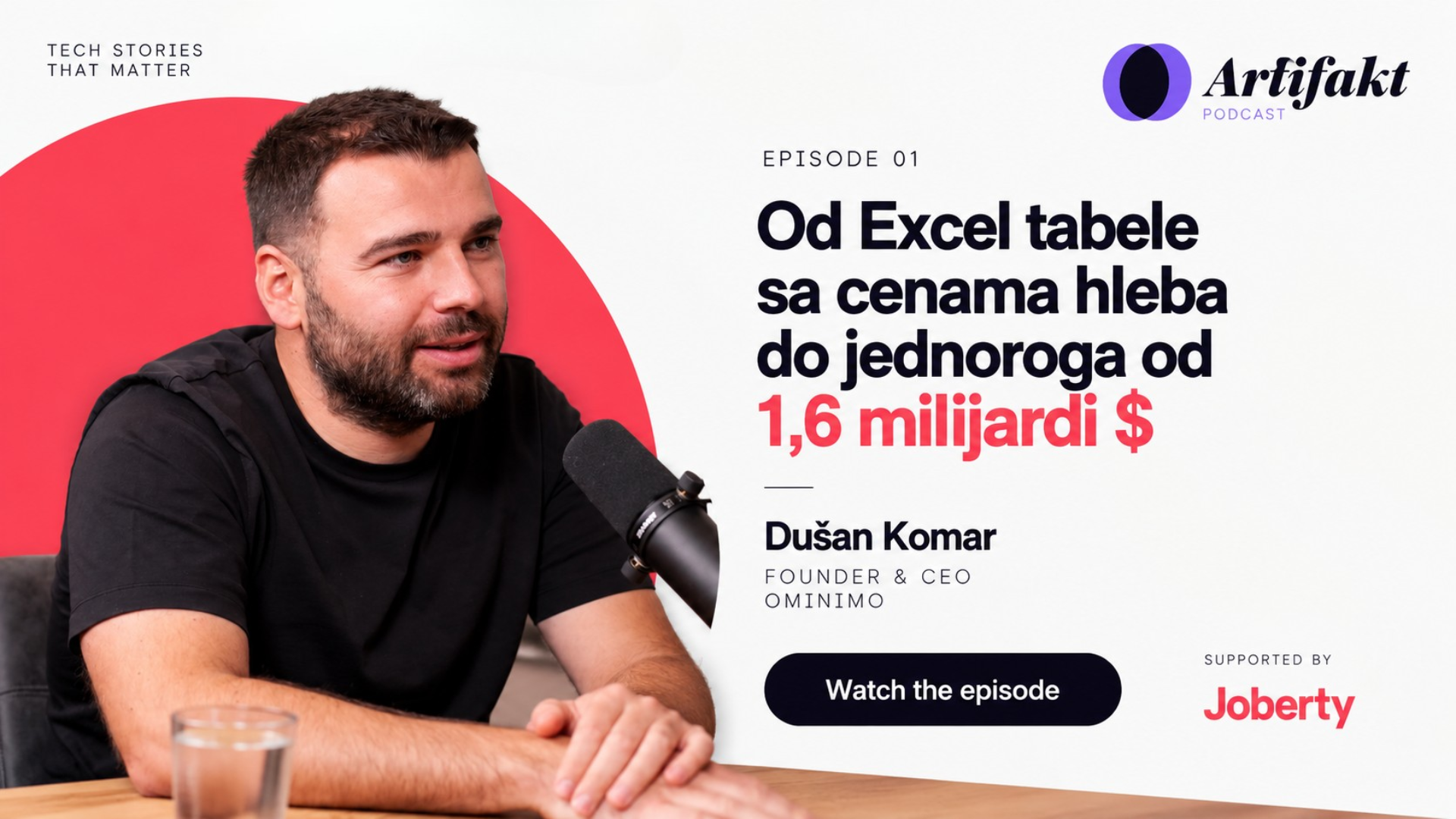
From Excel Sheets to a $1.6B Unicorn Ominimo: Dušan Komar on Artifakt Podcast

Fifteen years ago, Dušan Komar returned to Serbia with a master’s degree from the London School of Economics and started working at the National Bank of Serbia.
His first assignment was not exactly what he had imagined. He spent the day manually copying hundreds of product prices from a supermarket website into an Excel spreadsheet.
His salary at the time was 57,000 RSD, while his apartment in Belgrade cost 42,000 RSD per month. After three months, he gave up the apartment and started commuting from Novi Sad.
Today, Komar is the founder and CEO of Ominimo, an insurtech company valued at more than $1.6 billion.
In the first episode of Artifakt, he sat down with Maja Voje to talk about what happened between those two points: studying in London, twelve years at McKinsey, building an insurance company from scratch, finding the right co-founders, scaling across Europe and creating a company where data science sits at the center of the business.
Here are some of the most interesting ideas and numbers from the conversation.
1. Ominimo went from a few policies a day to more than 1,000
Ominimo launched its first market, Hungary, in 2024.
The beginning was not particularly spectacular. One policy sold one day. Two the next. Then three. Then none.
For a founding team that had previously worked on similar insurance projects at McKinsey, the numbers were worrying enough to make them question whether they had misunderstood the market.
Then Ominimo went live on Netrisk, Hungary’s largest insurance price comparison platform.
Sales jumped from a few policies a day to more than 500. A few weeks later, they passed 1,000 policies per day, five to ten times above the assumptions in the original Hungarian business case.
Its insurance partner Signal Iduna had spent around 30 years at roughly 2% market share in Hungary. According to Komar, the partnership with Ominimo helped increase that share to 9% within a year.
The interesting part is not only the speed of the growth. It is how uncertain things still looked immediately before it happened.
The founders had already left established careers and spent months building the underlying insurance and pricing infrastructure. Yet during those first days, they were still watching individual purchases arrive and wondering whether they had made the right decision.
2. The real product is better risk prediction
Car insurance looks simple from the customer's perspective: find a policy, compare the price and buy it.
Behind that price is a prediction problem.
Traditional insurers, Komar explained, may use a relatively small number of variables and linear models to group drivers into risk categories. But two drivers placed in the same category do not necessarily represent the same risk.
Instead of treating a market of five million drivers as a limited number of broad groups, the goal is to estimate risk as individually as possible using more variables, nonlinear models, and frequent pricing updates.
That matters because inaccurate segmentation creates cross-subsidization: lower-risk drivers can end up paying more than their individual risk would justify, while higher-risk drivers pay less.
Ominimo's bet is that better prediction allows it to identify attractive risk more precisely, and therefore offer competitive prices to the customers it wants to acquire.
As Komar put it during the conversation, the basic idea itself is not revolutionary. Every insurer would like to attract good risks.
3. 167 variables are only the beginning
That philosophy becomes particularly visible inside Ominimo's data science operation. During the conversation, Komar mentioned 167 variables used in its work, but even that number does not capture the full picture.
Teams also create synthetic variables by combining existing ones and continuously experiment with different inference techniques and models, including GLMs and XGBoost.
The objective is to separate useful signal from noise. And experimentation is not treated as something occasional. It is part of the operating model.
Teams test different approaches, work in test environments before production, and use A/B tests when appropriate. Komar described the company almost as a laboratory where the cost of trying something new should be kept low enough that people are comfortable experimenting.
That philosophy now extends to AI-assisted software development as well.
The point, however, is not simply to adopt the newest AI tool. It is to make experimentation cheaper and faster while maintaining the controls needed before changes reach production.
4. Growth does not have to mean entering every market as quickly as possible
Ominimo's expansion strategy is surprisingly cautious for a company growing this quickly.
After launching Hungary in April 2024, the company waited roughly 15–16 months before entering its next market.
The reason was operational readiness. At one point, rapid customer growth in Hungary created a backlog of more than 10,000 unanswered emails, with some customers waiting 10 to 15 days for a response.
At the same time, Ominimo had built its own core insurance platform rather than buying an established industry solution. The team still needed to see whether that infrastructure could reliably support hundreds of thousands of users.
Instead of immediately adding more countries, they first worked on those problems.
Only once the operating model and technology had proved they could handle the scale did expansion accelerate.
Ominimo now operates across four markets. Komar said the company expects to launch in another five or six European markets over the following 18 months and has also begun the licensing process for the US.
The lesson is an unusually simple one for hypergrowth companies: being able to enter a market and being ready to enter it are not the same thing.
5. Meet customers where they already are
Ominimo also made a deliberate choice not to build its growth strategy around brand awareness.
“If the customer is already at a broker or on those websites, then we'll come to the customer,” Komar explained in the episode.
That means comparison platforms and search rather than trying to convince customers to visit Ominimo first. The company does invest in Google Search when someone is actively looking for a policy, but according to Komar, it does not spend on traditional brand-awareness channels such as billboards or TV campaigns.
For a product most people see as a necessity rather than something they enjoy shopping for, the distinction matters.
Ominimo is not trying to make customers love buying car insurance.
It is trying to make the process cheaper and faster.
6. Young talent gets real responsibility early
The average age at Ominimo is around 25, and many employees join directly from university, including through hackathons and regular graduate recruitment.
Komar believes compensation and working conditions matter,
When Ominimo enters a new market, it does not necessarily deploy a huge data science organization. A team might consist of only five, six or seven data scientists working with oversight from more senior colleagues.
What that small team builds can then compete directly with products from some of Europe's largest insurers.
For someone early in their career, that creates a very different relationship with their work. Their contribution is not buried somewhere inside a large organization. They can see whether what they built reaches the market, and whether it works.
That also explains why Komar is skeptical of organizations in which seniority automatically determines whose idea wins.
7. “Kill the ego” is one of Komar's main principles for founders
Asked what founders can do to build an organization where talented people take initiative, Komar started with ego.
Smart people, he argued, do not want to work for someone who believes the founder or CEO must always know best.
His alternative is a relatively flat organization where the quality of an idea matters more than the seniority of the person proposing it.
Someone who joined a month ago should be able to challenge a founder if their idea is better.
The second part is delegation.
The belief that “if you want something done properly, you have to do it yourself” simply does not scale. If a company has deliberately hired highly capable people, those people need enough autonomy to make meaningful decisions, including decisions that might occasionally be wrong.
That connects with another idea repeated throughout the episode: reducing the cost of mistakes. People experiment more when a wrong decision is survivable.
8. Success rarely looks linear while you're living through it
Before Ominimo, there was LSE, the National Bank of Serbia and twelve years at McKinsey.
None of those transitions felt particularly effortless. During his first year in London, Komar says he had a monthly budget of roughly €150 for food, his phone and the gym. At LSE, surrounded by students with strong backgrounds in mathematics and physics, he often felt academically behind.
The same feeling returned when he joined McKinsey. On his first projects, colleagues could produce an entire deck in the time it took him to make a single slide. Some projects meant working until two or three in the morning, occasionally even later.
He did not get into McKinsey on his first attempt. He says becoming a partner also took a second try.
His takeaway from those experiences is straightforward: if something is difficult and worth doing, it may deserve at least one more attempt.
That is perhaps the most useful context for the headline numbers surrounding Ominimo today.
A $1.6 billion valuation, hundreds of thousands of customers and rapid international expansion can make a company look like an overnight success.
The first episode of Artifakt tells a much less linear, and much more interesting, version of that story.
From manually copying prices into Excel to building risk models with hundreds of variables, from wondering whether the first few customers would ever arrive to selling more than 1,000 policies a day, the distance between those points was filled with uncertainty, wrong turns, experimentation and repeated attempts.
And Ominimo is still very much in the middle of the story.
Watch the full first episode of Artifakt with Dušan Komar to hear the complete conversation about Ominimo.